

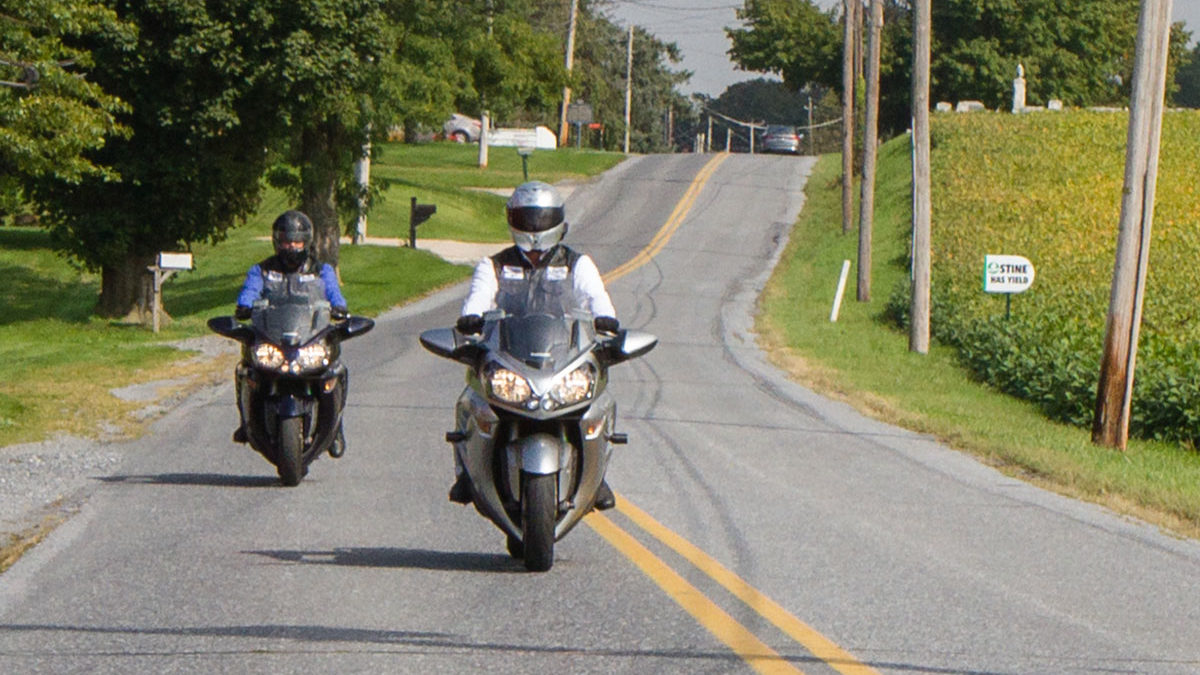

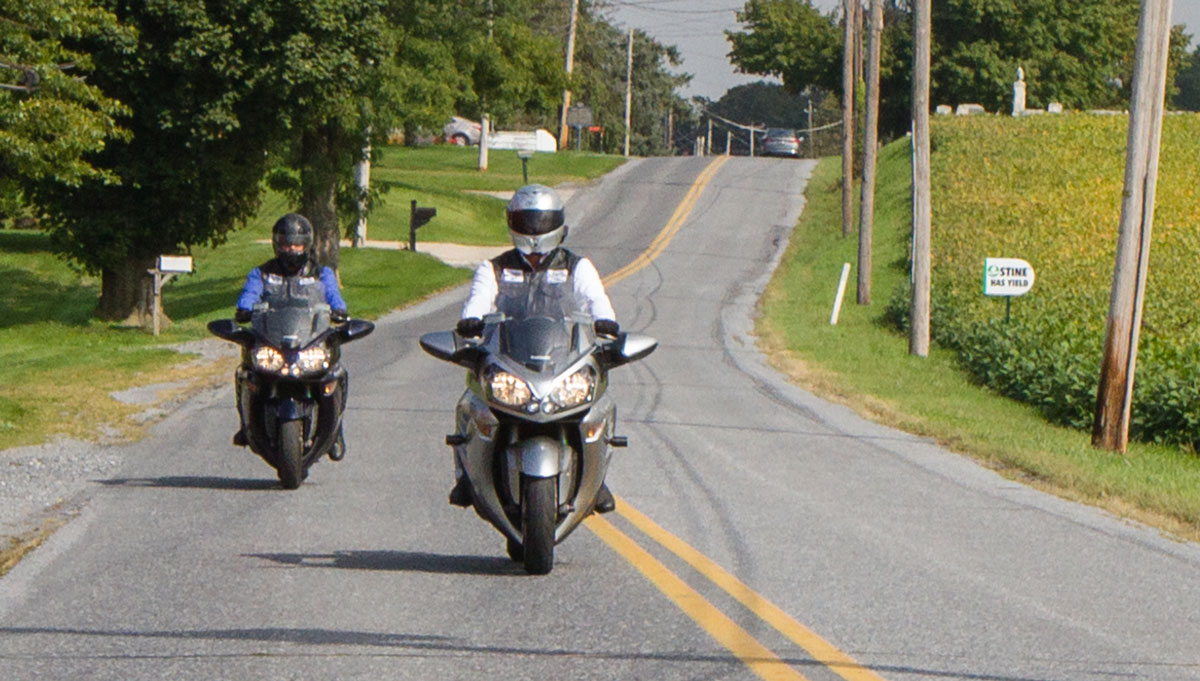
A motorcycle is a chrome and leather emblem for speed, maneuverability, and freedom.
Often viewed as a bold departure from conformity and an unapologetic icon of the counter-culture, the motorcycle has become a fitting vehicle for PACB’s “Rolling for Repeal” public awareness campaign.
PACB’s new chairman, Troy Peters, and long-time PACB President Nick DiFrancesco, kicked off their innovative messaging tour on Monday, October 2 to flatten the regulatory speed bumps on community banking’s journey to success. Both men wore vests inscribed with the “Rolling for Repeal” message, hopped upon their bikes to ride the open road, and roared into town with a powerful message. For Peters, Jonestown Bank and Trust Company’s trademark message to “Bank with a Smile” morphed into a “Bike with a Smile” mantra.
A full-throttle motorcycle tour is not new for DiFrancesco, who embarked upon a statewide tour on his Harley when he was running for Lieutenant Governor in 2009 and 2010.
Peters and DiFrancesco set out on the first leg of their motorcycle messaging tour on an unseasonably warm October Monday, to cruise in to Northeastern Pennsylvania’s Jim Thorpe Neighnorhood Bank (JTNB) and ESSA Bank & Trust in scenic Stroudsburg.
Bank employees greeted the pair of reform riders, eager to share the effects of increased regulation on their job and check out the bikes. The group had the opportunity to speak to the media at both stops and share the stressors that weigh upon community banking. They also took the time to meet with employees and customers directly affected by today’s suffocating governmental regulations.
They were joined at the JTNB stop by the Carbon County Commissioners, Tom Gerhard, Vice-Chairman, and William O’Gurek, Secretary, along with Kathy Henderson, Director of Economic Development at Carbon County’s Chamber.
Jim Thorpe is a popular tourist destination, once known as Mauch Chunk, before being renamed in honor of this nation’s first Native American to win a gold medal in the Olympics. It is a picturesque enclave nestled at the base of the scenic Pocono Mountains along the Lehigh River, and is beloved by hikers, skiers, fishermen and snowmobilers.
The area’s natural beauty and autumn leaves stood in sharp contrast to the picture bank leaders painted.
The Commercial Loan Officer from JTNB, Eugene “Gino” DiGiosio, insightfully noted the stark difference between getting a loan from a regional bank and a loan from a community bank. If a sought-after loan is less than $100,000, the big banks view the loan as “not worth their time,” he said. He witnessed this dismissive attitude first-hand when he spent a decade working for a regional bank. Meanwhile, community bankers know their people and are much more willing to finance their biggest dreams, even for the smallest of new businesses.
At the ESSA Bank & Trust pit stop, DiFrancesco and Peters were joined by Gary Olson, CEO; Chuck Hangen, Executive Vice President, COO; and Pete Gray, Executive Vice President, Director of Strategic Initiatives. Also on hand were Allan Muto, Executive Vice President, CFO, and Jim Gillen, VP Strategic Planning/Business Development Director.
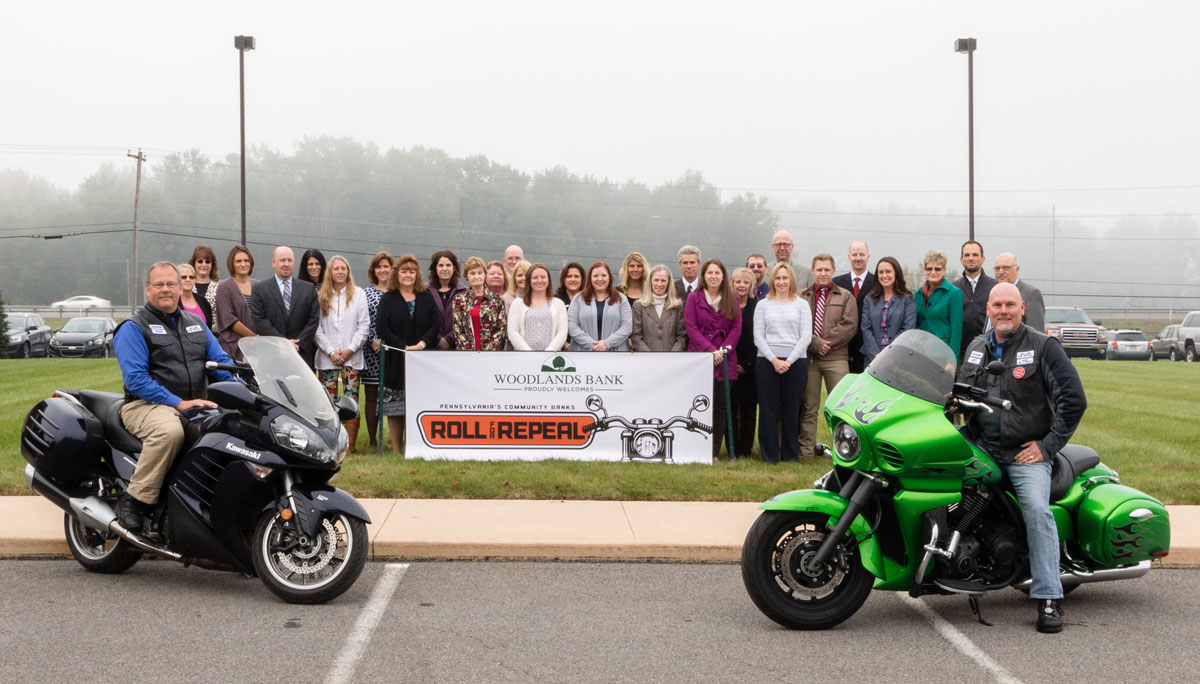 At both stops, they spoke about the pressing need for the repeal of the Wall Street Reform and Consumer Protection Act of 2009, to ease the regulatory burden weighing down like an anchor on the community banking industry and its customers.
The October 2 trip was featured in the <em>Pocono Record<em> and on the evening TV news, WBRE.
Many speakers said that the increased regulations enacted after the 2008 meltdown require an exponential increase in compliance officers and documentation. Front-line tellers have been converted into “the Gestapo,” as one bank leader described it—all despite the fact that the smaller community banks were innocent actors in the financial meltdown.
“Regulatory fatigue” is leading to bank closures, a last-gasp wave of mergers to reduce overhead costs, and a dearth of new banks. These skyrocketing regulatory costs affect every bank’s bottom line and, ultimately, the way banks serve the community, they said. It is far more challenging for customers to obtain a loan or mortgage, and far more difficult for banks to keep giving back to the community as they have done for decades.
DiFrancesco said that the shorthand “Dodd-Frank” term has become “a political lightning rod,” as pro-Dodd Frankers are mistakenly viewed as pro-consumer, and pro-middle- and lower-class, while anti-Dodd Frankers are viewed as pro-Wall Street, pro-big banks, and pro-the jet set. This is patently false, which is why Peters, DiFrancesco and others are urging elected officials to put the brakes on painting all banks with the same broad brush.
Bipartisan legislation, now pending at the federal level, has the promise of loosening the regulatory noose around the necks of community banks.
We can’t afford to lose more community banks, bankers said. The need is so urgent.
While the two Repeal Riders will take a brief hiatus from their motorcycle tour in the winter months, they will fire up their engines again for several more rounds of travel in the spring.
In the end, biking for freedom is not about just the future of community banks, but the people banks serve—and their future—the young families, the college students, the budding entrepreneurs, the retirees.
The two turbo-charged “rollers” hope their efforts will secure the freedom they instantly feel on the open road.